
The Problem With AI and Kids Isn't the AI. It's What They Do With It.
The podcast that fooled an AI expert wasn't the real story. What his kids were doing with it was.
On a family car trip, Daniel Susskind, an economist who has spent fifteen years studying how AI is reshaping work and has just published a book on how parents should prepare their children for it, put on a children's history podcast called History's Not Boring. It was only partway through that his wife worked out what was actually happening: the show's two child hosts, who sounded exactly like real kids chatting their way through history, didn't exist. The whole thing, hosts included, had been generated end to end by AI.
The point wasn't that the podcast was good. It's that no one could tell.
Susskind, writing about the moment in The Guardian, isn't in the business of being easily fooled by AI. That's precisely what makes the anecdote worth sitting with. If a format can pass as authentic to an adult who studies this technology for a living, it was never going to announce itself to a five-year-old. The interesting question isn't whether AI-generated content for kids exists. It obviously does, and it's getting harder to spot, not easier. The interesting question is what it's actually doing to a child sitting there absorbing it.
Passive AI content, not AI itself, is what's doing the damage
Teachers interviewed by EdSurge this month describe the same blurring playing out at scale, earlier, in early childhood. Professor Keri Ewart put it plainly: when an AI-generated video's words and images don't line up with reality, “cognitive disparity is causing children to learn inaccurately,” and because young children are still building the mental tools to separate fact from fiction, they have no way to catch the error themselves. Educator Allison Bacon went further, calling AI content built purely to occupy a child's attention “inherently problematic” given how much is still developing in a young brain. One YouTube channel alone had generated nearly 5,500 videos in under a year, the vast majority of it not educational content at all, just AI output optimised to keep a toddler watching a little longer.
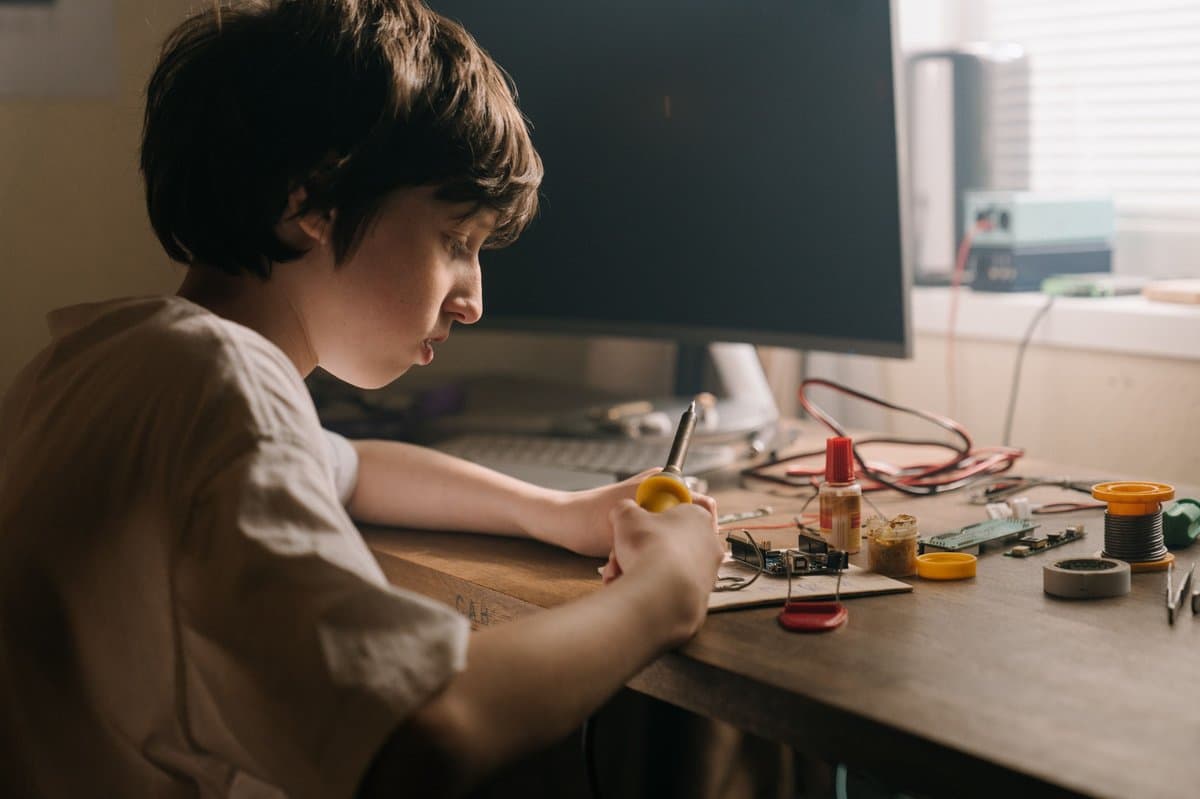
None of that is an argument against AI near children. It's an argument for being precise about which half of “AI and kids” is the actual problem. A child watching an AI-generated video make decisions for them, what's true, what's interesting, what happens next, is a fundamentally different experience from a child using AI as a tool while they do the deciding themselves.
- Passive: an AI video plays and a child watches, no decision ever asked of them
- Active: a student prompts an AI, gets an answer, and has to judge whether it's actually right
- Passive: content is optimised to hold attention, not to teach anything in particular
- Active: a wrong answer becomes a specific, visible gap the student can see and go fix
“Learn to code” was already out of date. AI just proved it.
Susskind's own example of how fast the ground has moved: in 2013, the UK government pushed coding into every primary and secondary school as the way to future-proof a generation. By January 2026, Anthropic was reporting that roughly 90% of the code behind its own Claude Code tool was being written by AI, not people. The future-proofing advice from barely a decade ago has already been overtaken by the thing it was supposed to prepare children for. Syntax was never the scarce skill. Knowing what's worth building, and being able to tell whether an AI's answer is actually right, always was.
The other half of the story: mistakes as data, not AI output as content
There's a useful, quieter idea running through a separate piece in eSchool News this month, about what actually makes practice useful. The core argument: a raw score tells you something went wrong, but not what. Structuring practice around specific, named learning objectives, and reviewing results objective by objective rather than as one overall percentage, turns a wrong answer into a precise, fixable gap instead of a vague mark. The tools help surface the pattern. A teacher, or in our case a founder-mentor, still has to judge whether a mistake reflects a genuine misunderstanding, a careless slip, or something the student hasn't been taught yet.
That's the same principle our own curriculum is built on, just applied to building software instead of answering quiz questions. A student doesn't get handed an AI tool in isolation. By the time AI enters the picture, in Phase 3, they've already built the fundamentals by hand, so they can actually judge whether what the AI hands back is right, not just accept it because it sounds plausible, the exact failure mode Susskind's podcast anecdote is really about.
“AI didn't invent passive learning, it just made passive content infinitely cheap to produce. The question was never whether a child uses AI. It's whether they're doing the thinking, or just watching the AI do it for them.”
Muhammad Mostafizur Rahman, Founder, PsyntaxLabs Academy
The question worth asking about your child's screen time now
It's no longer enough to ask how many hours a day involve a screen, or even how many involve AI. The more useful question is simpler: in the time your child spends with AI, are they the one making the decisions, or is the AI making them while your child just watches? One builds the exact judgement Susskind's own family got caught out without. The other quietly erodes it.
If you want to see what active, AI-assisted building actually looks like for an 11-19 year old, not another passive video, but a real product they build and can defend themselves, apply for our next intake. We'll show you exactly what your child would be building, and where AI fits into that process as a tool, not a babysitter.